Details change the experience.

Knowledge

Better answers lead to better outcomes.

Most fitting problems are diagnosed faster by asking a better question than by changing a product. This is the material we use to ask better questions.

Challenge
When something does not work, the first question asked is often about the product rather than about the situation.
Why it matters
A better first question saves a fitting, a size change, or a month of discomfort.
Our approach
We publish symptom-led troubleshooting, check questions and research notes that state what a result does not show.
Evidence
Research notes, instructions and documented method.

Troubleshooting

Start from the symptom.

Possible causes, questions to check, and a recommended next step. Never a diagnosis.

The socket or liner rotates during walkingAll

Possible causes

  • Size selected on a single measurement point
  • Reduced volume during the day
  • Seal or membrane placement
  • Textile stretched beyond intended range

Check questions

  • Was the size checked at both measurement points for this product?
  • Does rotation increase later in the day?
  • Is the sealing membrane sitting where it was fitted?
  • Has the same liner been in use beyond its expected service life?

Recommended next step

Bring the observation to your clinic and describe when rotation happens, not only that it happens. Clinicians: re-measure before changing size.

Redness or pressure marks at the proximal edgeAll

Possible causes

  • Edge loading at the brim or sleeve edge
  • Downsizing beyond intended fit
  • Skin sensitivity to lotion or cleaning residue
  • Donning technique folding the textile

Check questions

  • Where exactly is the mark, and how long does it stay after doffing?
  • Was the product downsized to improve stability?
  • Has any cleaning product or lotion changed recently?
  • Is the textile folding during roll-on?

Recommended next step

Marks that do not fade within about 20 minutes should be assessed by a clinician before continued use.

Sweat and heat build-up during the dayuser

Possible causes

  • Activity level and ambient temperature
  • Textile saturation
  • Cleaning routine
  • Sock layering

Check questions

  • Does the build-up follow specific activities or the whole day?
  • Is the liner fully dry before donning?
  • How often is the textile washed, and with what?

Recommended next step

Start with the cleaning and drying routine, then discuss options with your prosthetist rather than changing size first.

Knee flexion feels effortful at end rangeAll

Possible causes

  • Sleeve or liner thickness at the popliteal region
  • Size selected for stability rather than range
  • Product geometry not matched to the activity profile
  • Socket edge interaction

Check questions

  • Is the effort present when sitting, on stairs, on a bike, or all three?
  • Was size chosen to solve a suspension problem?
  • Which product profile is in use, uniform or tapered?

Recommended next step

Change one variable at a time and document it. We publish cases using exactly that method.

The seal or vacuum does not holdprofessional

Possible causes

  • Membrane placement
  • Sleeve edge over an uneven socket brim
  • Volume change during the day
  • Textile damage from overstretching

Check questions

  • Does the loss happen at a specific point in the gait cycle or over hours?
  • Is the socket brim edge smooth where the sleeve sits?
  • Has the sleeve been rolled rather than pulled during donning?

Recommended next step

Inspect the membrane and sleeve edge before adjusting size, and record when the loss occurs.

Identify your product

Which Nord° product do I have?

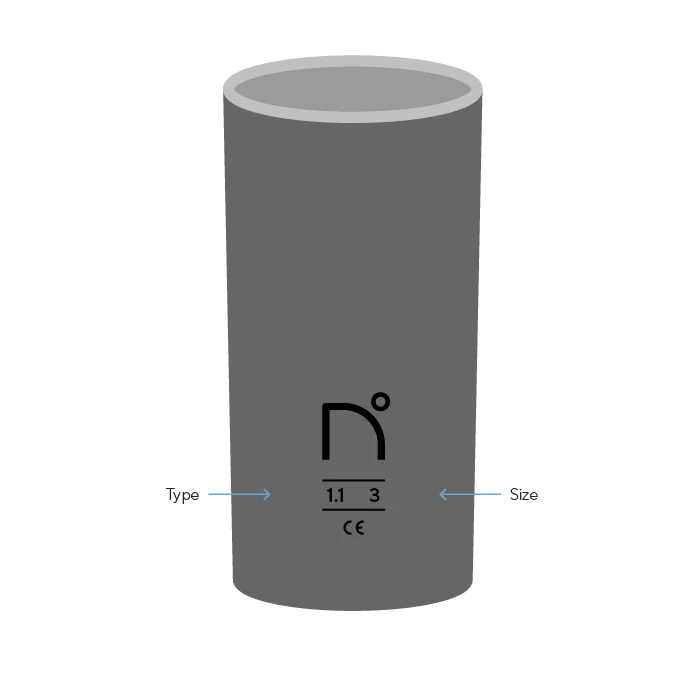
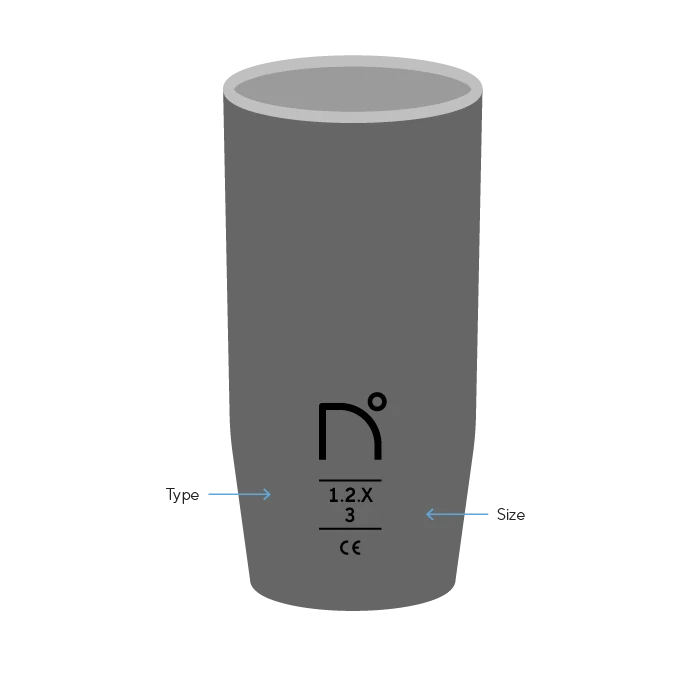
Compare the marking on your sleeve with the graphics below. If you are unsure, your CPO can confirm it from the part number.

How to identify a Nord° Sleeve 1.1.
How to identify a Nord° Sleeve 1.2.X.
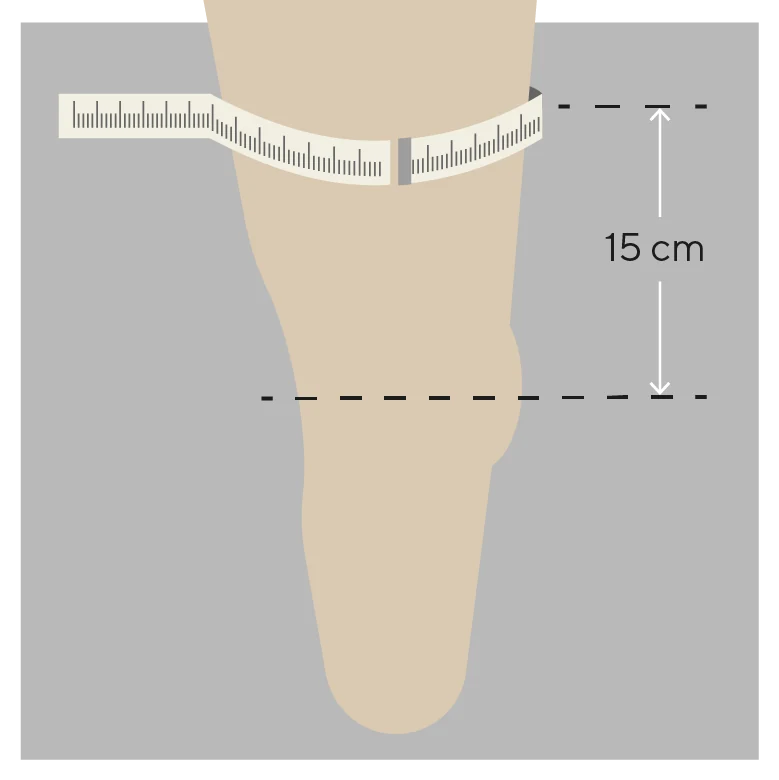
Measurement illustration for the Nord° Sleeve 1.1.
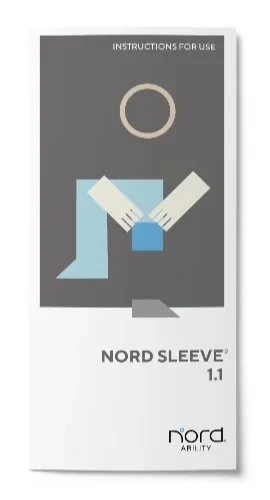
Cover of the Nord° Sleeve 1.1 user manual.

Research notes

What we asked, what we found, what it does not show.

A short, honest format. If a result is limited, the limitation is part of the result.

Research noteMaterial

TPE, silicone and gel: what do the labels actually tell us?

We asked
Does a material family name predict how a liner or sleeve behaves on the limb?
Method
Literature review of material family descriptions alongside our own formulation and textile data for the products we produce.
What the result shows
Family names describe chemistry, not behaviour. Formulation, thickness, geometry and textile explain far more of the difference a user feels.
What it does not show
This does not show that one family is better than another. It shows that the label is not a sufficient basis for comparison.
Research noteMovement

How much does knee flexion influence liner and sleeve choice?

We asked
Which everyday activities put a suspension solution closest to its restriction limit?
Method
Structured interviews with users and clinicians, mapped against the activities named most often: sitting, standing up, stairs, inclines, cycling and driving.
What the result shows
The activities named most often involve deep or repeated flexion rather than walking distance.
What it does not show
Interview frequency is not a measurement of restriction. This sets the priority for testing, it does not replace it.
Research noteResponsibility

A product-level LCA: what was included and what was not

We asked
What does a product-level CO2e figure cover, and what falls outside the boundary?
Method
LCA conducted following the principles of ISO 14040/44 for the products where a figure is published.
What the result shows
Published figures cover the defined product system for a stated size. Where no figure is published, the LCA is still in progress and we say so.
What it does not show
A single CO2e figure does not describe the whole environmental picture, and figures for different sizes are not interchangeable.

A result with a stated limit can be used in a clinic. A result without one has to be trusted, and trust is not a specification.

Why we publish limitations